
Q1 2026 Business Aviation Market – Key Observations
Despite a challenging geopolitical backdrop, the business aviation market in Q1 2026 remains notably resilient.
Activity levels continue to hold, with global flight activity up approximately 4–6% year-on-year, supported by sustained utilization and continued charter demand. While geopolitical developments are weighing on activity in parts of the Middle East, global activity remains positive overall — supported by strength in other regions — indicating that the impact is, at this stage, regionally contained rather than systemic, with early signs of stabilization emerging. This sustained level of operational activity is also reflected in the transaction market, though not uniformly.
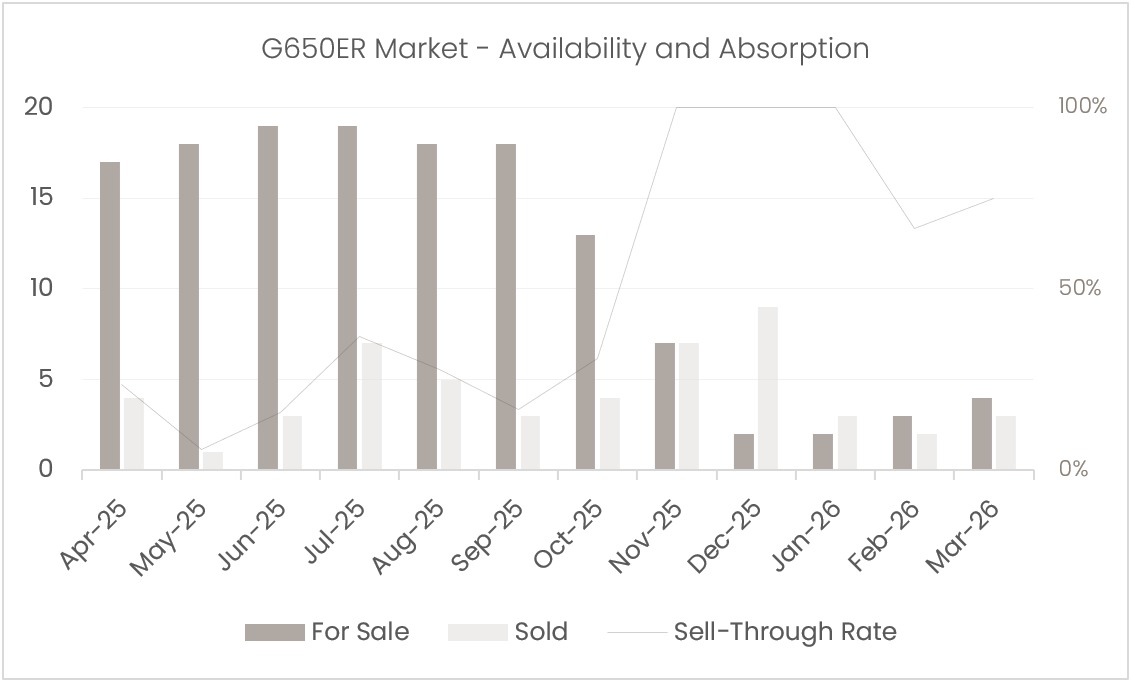
Against this backdrop, the market is not moving in a single direction, with supply conditions evolving unevenly across segments. Nowhere is this more evident than in the ultra-long-range segment, where availability has tightened materially in recent months — as seen in aircraft such as the G650ER — underpinning strong absorption and premiums above estimated retail values, extending a trend already established towards the end of the year.
Across the broader large-cabin and super-midsize segments, demand remains present but is being applied with increasing selectivity across both US and international markets.
Liquidity is becoming distinctly asset and configuration-driven, with specific layouts and specifications commanding stronger interest, as seen in aircraft such as the G550. This pattern extends across generations: newer, well-positioned aircraft continue to transact efficiently, while higher-hour or less competitive examples are experiencing extended marketing periods.
As a result, transaction outcomes are increasingly aligned to asset-specific characteristics rather than headline guide values, as illustrated by more balanced conditions in platforms such as the Global 6000 or Falcon 7X. The market is therefore evolving into a more selective environment, where outcomes are increasingly driven by asset quality, configuration, and positioning rather than by broad market direction. In this context, the upper tier of the pre-owned market is once again exhibiting characteristics of an ultra-premium segment, with certain aircraft now transacting on different terms.